Cambridge professor in biodiversity visits The Wilderness
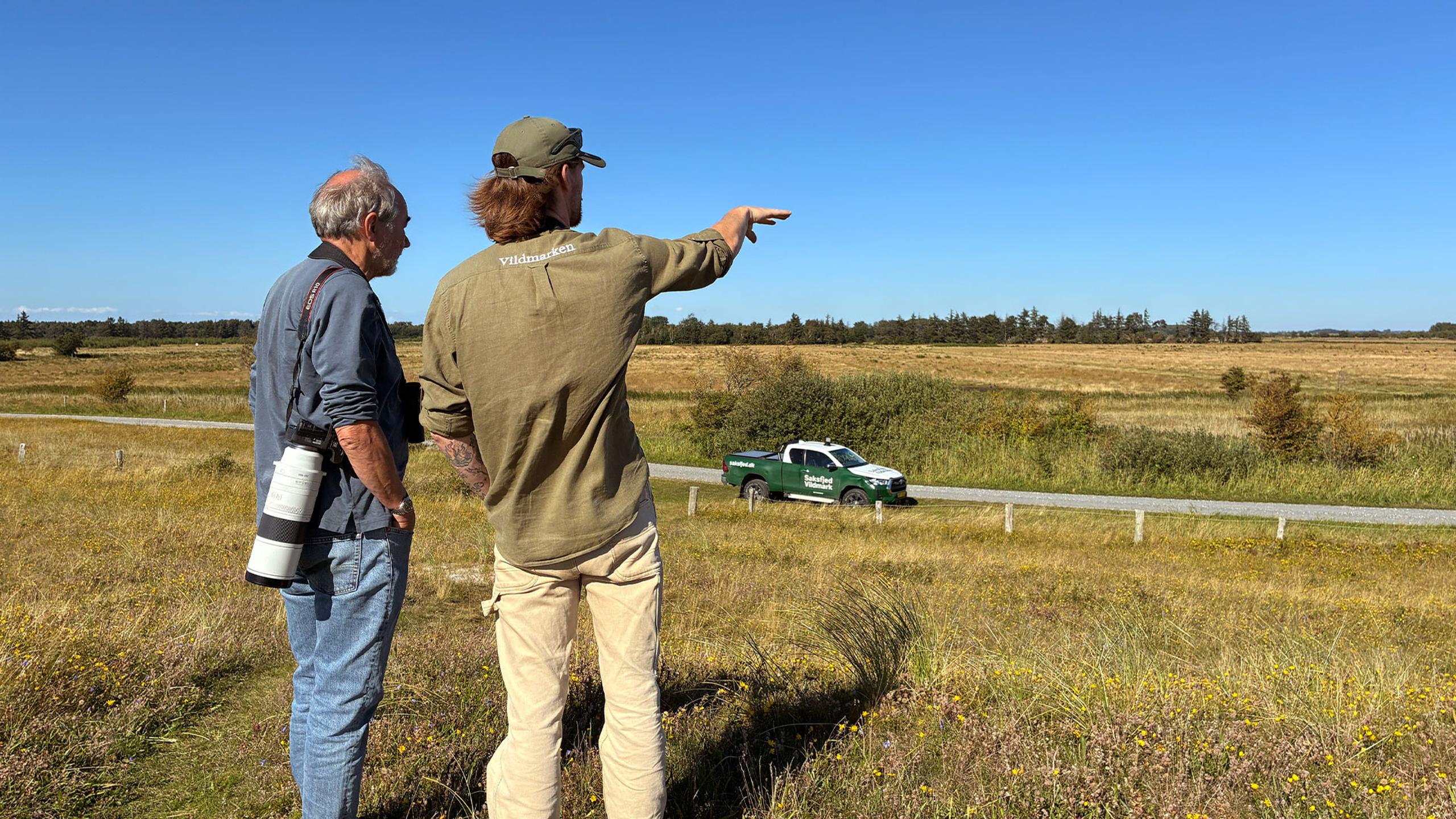
What can other countries learn from rewilding in Denmark? That was the question that Bill Sutherland, a professor of nature conservation, brought with him to Vildmarken, where he interviewed us about our work on rewilding.
That was the question that Bill Sutherland, Professor of Conservation, brought with him to Vildmarken to investigate our approach and experiences in creating more wild nature.
Rewilding can take very different forms from country to country. Across Europe, different approaches are being tried, and new insights are being gained that help to advance the work on rewilding. That is why it is valuable to share experiences across national borders. In this way, we can both share what we ourselves have learnt and gain a better understanding of the experiences of others.
Visit from the University of Cambridge
We recently welcomed Bill Sutherland, a professor at the University of Cambridge who specialises in nature conservation. Through his work, he keeps abreast of the latest research in nature conservation and restoration and shares his knowledge and perspectives on his YouTube channel.
Bill visited the Mols Laboratory, Saksfjed and Nørholm, where he interviewed, amongst others, the CEO of the Hempel Foundation, Anders Holm; the head of Vildmarken, Thor Hjarsen; and the nature manager at Saksfjed, Frederik Josefsen. The discussions centred, amongst other things, on our work with large grazers, nature restoration and evidence-based initiatives.
Bill’s visit is an example of how experiences from Denmark can be relevant in an international context. At the same time, meeting researchers and experts from other countries gives us the opportunity to gain new perspectives on our own work.
I'm really impressed by all that Hempel is doing. And the fact that they're using evidence and rewilding principles means that you have areas that are showing really exciting promise.
Knowledge must be shared – with the whole world
We support Bill’s mission to share knowledge and bring about change through the knowledge we already have – and that which we help to create together.
Next year, we look forward to bringing together researchers from near and far for the International Rewilding Conference, where we can share experiences, perspectives and the latest research in the field of nature restoration.
In addition, we are collaborating with Aarhus University and the University of Copenhagen to compile the latest knowledge and documented effects of nature restoration – both in Denmark and across national borders.
Our ambition is to bring the sector together and create a strong, shared knowledge base that can help us all understand better how best to restore nature. Because when we share what we know and learn from each other’s experiences, we can strengthen our efforts and contribute to nature restoration on a much larger scale.
Read more about the International Rewilding Conference 2027 here.
The river where the water flows freely
In many rivers and streams, fish find it difficult to move about due to various barriers. This is not the case in the Nørholm Wilderness. Listen to Thor Hjarsen talk about the unique Varde River system, where there are no barriers between the sea and the stream, and what this means for wildlife in and around the stream.
Can tauros restore the aurochs’ ecological role?
In the video, Frederik Josefsen talks about the history of the aurochs, the tauros breeding programme and the impact these large grazers are already having on the landscape at Saksfjed Vildmark.